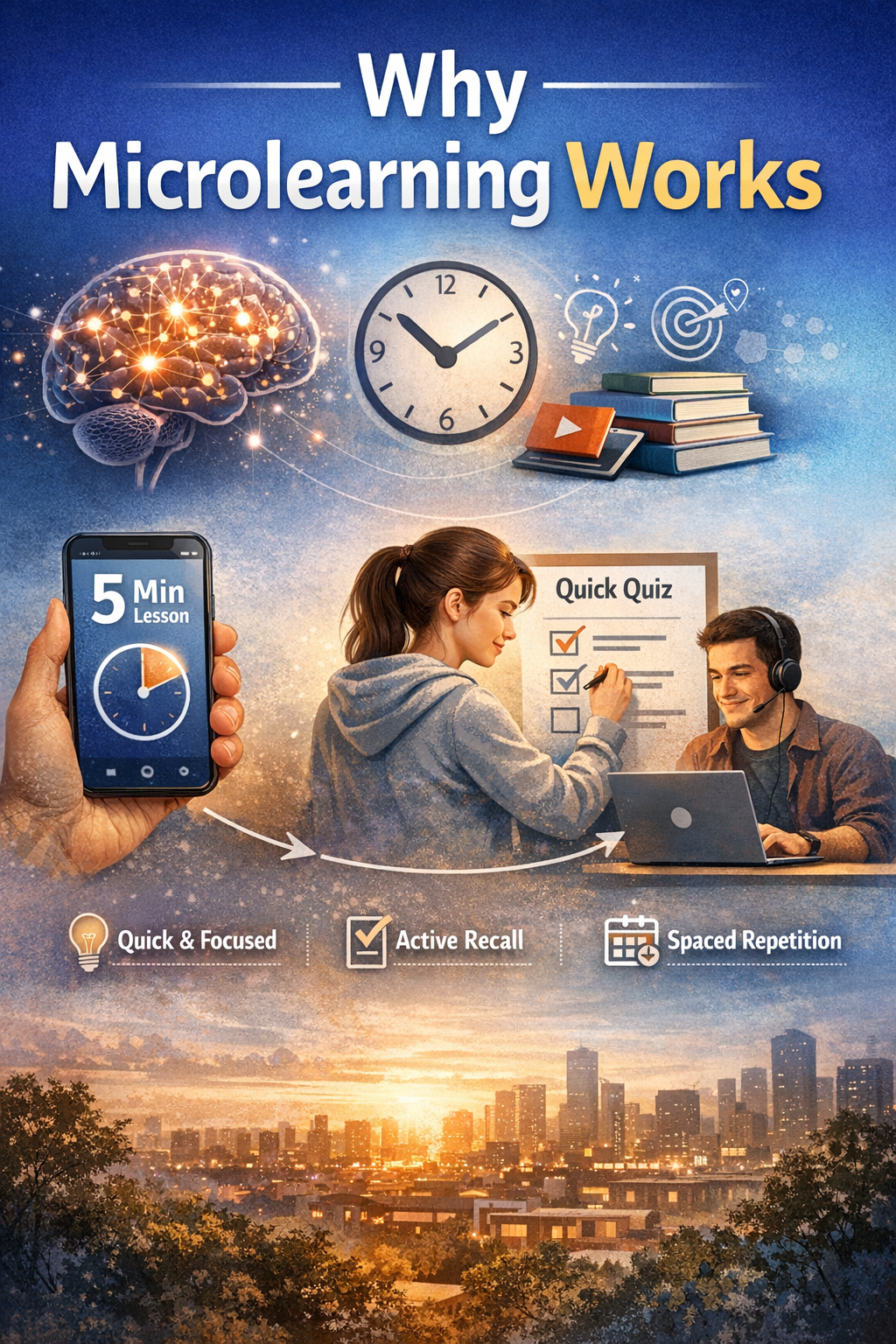
In a world where time is scarce and attention is constantly divided, traditional learning methods are no longer enough. Long lectures, dense textbooks, and information overload often lead to one result: low retention and low engagement. This is where microlearning stands out—not as a trend, but as a scientifically grounded approach to learning.
What Is Microlearning?
Microlearning is a method of delivering content in small, focused, and structured units, typically lasting between 3 to 10 minutes. Each unit is designed to achieve a single, clear learning objective.
Instead of overwhelming learners with large volumes of information, microlearning breaks knowledge into manageable pieces—making it easier to process, understand, and remember.
The Science Behind Microlearning
Microlearning is effective because it aligns with how the human brain actually works. Several well-established principles from cognitive science explain why.
1. Reduced Cognitive Load
The human brain has a limited working memory. When too much information is presented at once, it becomes difficult to process and retain it. This is explained by Cognitive Load Theory.
Microlearning reduces this burden by:
- Delivering information in small chunks
- Focusing on one concept at a time
- Eliminating unnecessary complexity
This allows learners to process information more efficiently and build understanding step by step.
2. Better Retention Through Retrieval Practice
One of the most powerful learning techniques is retrieval practice—actively recalling information instead of passively reviewing it.
Microlearning often includes:
- Short quizzes
- Reflection questions
- Quick applications
These elements force the learner to retrieve knowledge from memory, strengthening neural connections and improving long-term retention.
3. The Spacing Effect
Research consistently shows that learning is more effective when it is spread over time, rather than concentrated in one long session.
Microlearning naturally supports this by:
- Encouraging daily or regular short sessions
- Allowing repetition without fatigue
- Reinforcing knowledge over time
This leads to stronger memory consolidation and deeper understanding.
4. Increased Engagement and Motivation
Short learning sessions feel more achievable. This has a direct impact on motivation.
Microlearning:
- Reduces psychological resistance to starting
- Provides quick wins and a sense of progress
- Fits easily into daily routines
As a result, learners are more likely to stay consistent, which is one of the most important factors in successful learning.
5. Just-in-Time Learning
Microlearning is ideal for on-demand knowledge.
Instead of learning everything upfront, users can:
- Access specific information when needed
- Solve real problems immediately
- Apply knowledge in real-world situations
This makes learning more relevant, practical, and effective—especially for professionals.
Microlearning vs Traditional Learning
Traditional learning often focuses on depth in a single session, while microlearning focuses on progress over time.
| Traditional Learning | Microlearning |
|---|---|
| Long sessions | Short sessions |
| Information-heavy | Focused and targeted |
| Passive consumption | Active engagement |
| Low flexibility | Highly flexible |
| Lower retention | Higher retention |
This does not mean traditional learning is obsolete—but it does mean it can be significantly improved when combined with microlearning principles.
When Microlearning Works Best
Microlearning is especially effective when:
- Learners have limited time
- Content can be broken into clear steps
- Regular practice is required
- Knowledge needs to be applied quickly
It is widely used in:
- Professional education
- Corporate training
- Online certification programs
- Skill-based learning platforms
The Key Insight
Microlearning works not because it is shorter—but because it is smarter.
It respects:
- The limits of human attention
- The importance of repetition
- The power of active recall
- The need for flexibility
Final Thought
The future of education is not about learning more in less time.
It is about learning better.
Microlearning represents a shift from information overload to structured, intentional, and effective learning—designed for how people actually live, work, and think.
If you are building a learning platform, designing a course, or improving your own study method, one principle stands above all:
Don’t teach everything at once. Teach the right thing, at the right time, in the right size.

Leave a Reply